
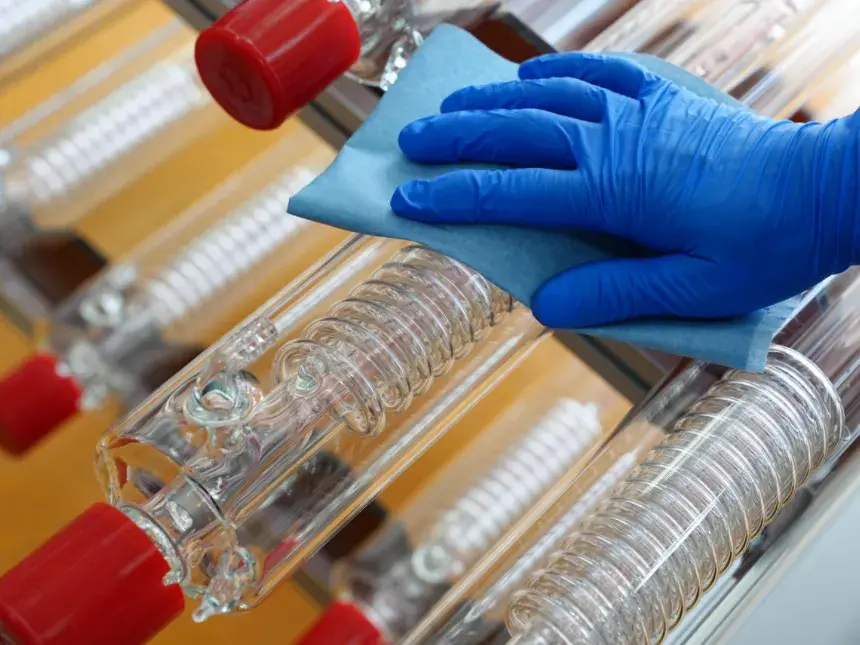
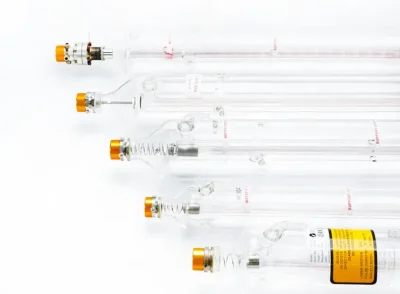
A CO2 laser tube is the core component of every laser cutting and engraving machine. Inside a sealed glass tube, a mixture of gases and a high-voltage electrical discharge work together to produce a laser. Here’s how it works.
The Gas Mixture and Each Gas’s Role
The main working substance inside a CO2 laser tube is a mixture of CO2, nitrogen (N₂), and helium (He), each serving a distinct purpose:
- CO2— The active laser medium. This is the gas that actually generates the laser radiation.
- Nitrogen (N₂)— An auxiliary gas that plays a key energy-transfer role. When excited, nitrogen molecules collide with CO2 molecules and transfer their energy, which greatly helps the accumulation of upper-level particles in CO2 and enables high-power, high-efficiency laser output.
- Helium (He)— Also an auxiliary gas. Helium accelerates the thermal relaxation of the 010 energy level and helps evacuate the lower laser levels (100 and 020), keeping the population inversion stable.
The Working Process
- Electrical discharge.A direct current of tens to hundreds of milliamps is applied in the discharge tube. When discharging, electrons impact and excite the nitrogen molecules in the mixed gas.
- Energy transfer.The excited nitrogen molecules collide with CO2molecules, transferring their energy. CO2 molecules transition from a low energy level to a high energy level.
- Population inversion.As more CO2molecules are raised to the upper energy level, a state of population inversion is created — more molecules exist in the excited state than in the ground state.
- Stimulated emission and laser output.The excited CO2molecules drop back to lower levels and emit photons at a wavelength of 10.6 µm (infrared). These photons bounce between the two mirrors at the ends of the tube — one fully reflective, one partially reflective — amplifying with each pass until a coherent laser beam exits through the output mirror.
Why Water Cooling Is Needed
CO2 laser tubes are only about 10–15% efficient at converting electricity into laser light; the rest becomes heat. Continuous water cooling through the surrounding jacket is therefore essential to prevent overheating and extend tube life.
Common Applications
The 10.6 µm wavelength is strongly absorbed by organic and non-metallic materials, making CO2 lasers ideal for cutting and engraving wood, acrylic, fabric, leather, paper, glass, rubber, and plastics.
Tips for Longer Tube Life
- Use distilled or purified cooling water and change it regularly
- Avoid running at maximum power continuously
- Keep mirrors and lenses clean
- Warm up the tube at low power before heavy use
We supply high-quality CO2 laser tubes with CE/FDA/RoHS certification.
Contact us to find the right tube for your machine.